Steel vs Plastic Pallets: Specifying Pallets for Racking
News Details
Steel Pallet vs Plastic Pallet: Which One Fits Your Warehouse?
Choosing between a steel pallet and a plastic pallet isn't just about price—it's about whether the pallet can actually do its job in your specific warehouse environment. Comparing materials in a vacuum doesn't help; what matters is how they perform in your racks, with your loads, and under your conditions.
Two key questions drive most of the decision: How is the pallet moved? (Forklift, hand pallet jack, or automated system?) And what's the environment like? (Washdown, freezing temperatures, chemicals, salt air, or dry storage?) Almost every other difference between steel and plastic pallets comes down to these two factors.
At Unionwade, we manufacture both steel and plastic pallets to order—so load capacity, dimensions, color, and surface treatment are all tailored to your project, not just picked from a catalog. Here's the practical takeaway: A pallet's load rating isn't generic to the material—it's specific to that exact order. Always compare the numbers on your two quotes, not just industry averages.
Steel Pallet Load Capacity: Static, Dynamic, and Racking Ratings Explained
Steel pallets typically come with three distinct load capacity ratings, and they're not interchangeable:
- Static load: The pallet sits stationary on a flat floor, supporting the load on top. Since the floor supports the entire deck, this is usually the highest rating.
- Dynamic load: The pallet is being lifted or moved by a forklift or pallet jack. Fork entry forces, braking, uneven floors, and shifting loads add stress that static testing doesn't account for.
- Racking load: The pallet is supported only by two rack beams, with nothing underneath the deck. The deck and support runners bend across the gap, rather than sitting in compression on a solid surface.
Of these three, the racking load rating is the most critical for warehouse storage—and it's almost always the lowest. A pallet that works fine on the floor can easily be overloaded when placed on a rack, leading to permanent sagging over time.
Load ratings are typically tested to standardized specifications, with ISO 8611 being the most widely referenced standard for pallets. When a supplier gives you a number, ask: Is this static, dynamic, or racking load? And how was it tested?
On a steel pallet, the deck thickness, support runners, and welds are what determine these ratings. Two pallets of the same size can have very different load capacities based on these details—so replacing a pallet based only on footprint size often creates a weak point in your racking system.
Plastic Pallet Racking Load: The Safety Number That Matters Most
Plastic pallets also use the same three-tier rating system, but the gap between static and racking loads is often wider. A plastic deck that's strong on a concrete floor performs much differently when it's spanning two rack beams—because a material that's great in compression has to work in bending instead.
This is where plastic pallet models vary the most. A nestable pallet designed for one-way shipping, a nine-leg pallet for manual picking, and a rackable pallet built for repeated use can look similar from above, but behave very differently across a beam gap. Only one of them is actually designed for rack storage.
Follow these practical rules: If the pallet goes into a rack, always use its racking load rating—not its static one. If your load can shift (like bags, liquids, or unsecured cartons), add extra margin, since shifting weight concentrates on a smaller section of the deck. And if you're stacking multiple levels high, a pallet that wasn't built for beam support will end up being more expensive in the long run.
| Factor | Steel Pallet | Plastic Pallet |
| Material & Finish | Welded steel, powder-coated or galvanized | High-pressure molded; uniform dimensions; steel-reinforced options available |
| Critical Rating for Racks | Racking load | Racking load (usually the widest gap below static rating) |
| Fork Entry | Four-way entry on three-runner bases; specified with load & size | Depends on base design: nine-leg, perimeter, or three-runner |
| Cold Storage | Suitable for cold storage with waterproof/rust-proof treatment | Low-temperature rating determines suitability; impact resistance drops in cold |
| Washdown & Hygiene | Washable if coating is intact; welds & edges need inspection | Repeated washing/steam cleaning; resistant to weak acids/alkalis |
| Common Damage Signs | Coating wear, rust, bent runners | Cracks/splits, often at fork entry points |
| End of Life | Fully recyclable steel | Recyclable; typical lifespan up to 10 years |
| Typical Applications | Machinery, chemicals, textiles, heavy parts, cold chain | Food, pharmaceuticals, closed-loop logistics, light goods |
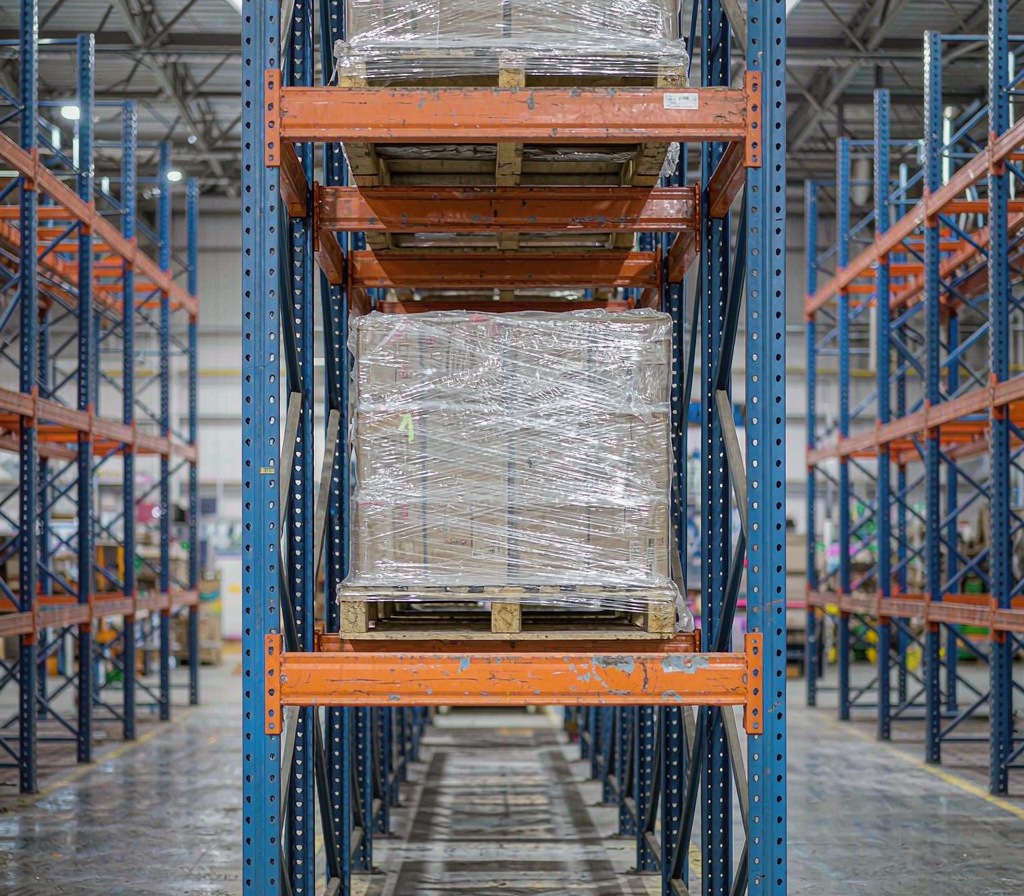
Four-Way Entry Steel Pallet: What the Base Design Tells You
Fork entry direction is often listed in the fine print on quotes, but it causes some of the most expensive on-site headaches. A two-way pallet can only be approached from one pair of sides, while a four-way pallet can be entered from either the long or short side.
This matters when you need to access a rack bay from an aisle you didn't originally plan for, when a forklift has to turn in a tight space, or when the same pallet is picked from the front in one shift and from the side in the next. In a narrow warehouse, it's often the difference between using the racking you have and rebuilding it.
The base design is what makes four-way entry possible—and it also tells you what the pallet is best suited for:
- Three longitudinal runners: Create two tunnels on the front and one long tunnel on each side—this is the classic four-way layout, and the stiffest option for spanning rack beams.
- Perimeter or cross-braced bases: Distribute weight across more of the underside, ideal for deep stacking and heavy point loads.
- Nine short legs: The lightest design, easiest for hand pallet jacks, but the least rigid when spanning a gap.
At goods-in, check two things: First, tunnel height against your actual fork thickness (not just nominal pallet height). Second, inspect tunnels after a year of use— a bent runner can close off a tunnel, turning a four-way pallet into a two-way one without anyone noticing.
Cold Storage: Where Steel Pallets Shine
Cold temperatures are a material problem before they're a handling problem. Freezers don't just make pallets cold—they make many materials brittle, and leave a layer of condensation on every surface that passes through the door.
Unionwade's steel pallets are designed with waterproof, moisture-proof, and rust-proof surface treatments, making them ideal for cold storage. This combination means a coated steel structure that doesn't absorb water—so defrost cycles and wet floors don't lead to constant corrosion issues.
Plastic handles moisture well, but impact resistance drops as temperatures fall. For freezer use, always rely on the pallet's low-temperature rating, not its ambient temperature rating. A pallet that works in a 5°C cold room won't necessarily perform in a -25°C freezer—and the difference usually shows up as cracks at the fork entry, not a sudden failure.

When a Steel-Reinforced Plastic Pallet Makes Sense
The middle ground is a plastic pallet with steel tubes molded into the deck or runners. The tubes don't change the material, but they improve how it performs across a rack beam gap—where plain plastic pallets often struggle.
This is a smart choice when three things are true at once: Your load is heavier than a standard plastic pallet can handle in a rack, your environment rules out steel (like washdown areas, weak acid exposure, or strict hygiene requirements), and the pallet stays in a closed-loop system where a higher upfront cost pays off over years of use.
It's the wrong choice if the reinforcement isn't actually included. Steel-reinforced models are usually a separate product line, not an option on every mold, and the difference is invisible from above—so you have to specify it explicitly on your order. For hygiene-focused facilities, also ask how the tubes are sealed: a reinforcement that lets water in at a damaged end defeats the purpose of a washable pallet.
Pallet Size for Racking Beams: Matching Footprint to Your System
Pallets and racking are one integrated system, and the two key dimensions that connect them are beam span and frame depth. Unionwade's heavy-duty pallet racking is built with bay lengths from 2,300 to 3,000 mm, depths from 800 to 1,000 mm, and heights up to 10,500 mm, with load ratings of 1,500 to 3,500 kg per level. These three numbers define the space your pallet needs to fit.
Depth is where most mistakes happen. A 1,000 mm deep pallet on an 800 mm deep frame leaves the front of the pallet hanging past the beam line, so part of the load is carried by the deck instead of the beam, and you lose aisle clearance you planned for. The pallet should sit fully supported on the beams, with its corners inside the beam edges.
Beam span is the other half of the equation. A pallet that's much shorter than the beam span sits too far inside the frame, wasting rack space; a pallet wider than the span overhangs the beam ends, with no support underneath. Common sizes like 1,200 x 1,000 mm, 1,200 x 800 mm, and 1,100 x 1,100 mm all work in standard bays—if the layout is designed around the pallet you'll actually use, not just the one in the catalog.
That's why you should finalize your warehouse layout before ordering pallets. Sending your supplier the pallet drawing, load per pallet, and handling equipment details doesn't cost anything—and it prevents the most common problem: a finished racking system that fits every pallet except the one you actually need.
Washable Pallets for Food & Pharmaceutical Storage
In facilities that run regular washdown shifts, cleanability isn't a nice-to-have—it's the core requirement. Unionwade's plastic pallets can be repeatedly washed and steam-cleaned, by hand or via automated systems, and are resistant to moisture, weak acids, and alkalis—qualities that let them survive strict hygiene routines, not just pass the first audit.
Steel pallets are also suitable for food and pharmaceutical use, and can be washed—but the key question is different. A powder-coated or galvanized surface cleans easily until the coating gets damaged; after that, welds, folded edges, and hollow section interiors trap water, where rust will show up during the next inspection. Steel pallets in hygiene-focused applications require ongoing maintenance, not just a one-time purchase.
For either material, always get a written cleaning specification: Which chemicals can be used, at what concentration, and which parts of the pallet can withstand steam cleaning. A pallet that meets food safety standards on delivery but fails in year three is almost always one where the cleaning method was never clearly defined in the order.
Galvanized Steel Pallets for Export & Humid Yards
Humidity is slow, invisible, and costly. A shipping container that crosses two climate zones, an unheated coastal warehouse, or an open yard that holds water after rain all damage the same surfaces—and the first sign of trouble is usually rust stains on your goods, not on the pallet itself.
Galvanized steel pallets solve this specific problem: The zinc coating continues to protect the steel even if the surface gets scratched, which is why it's the go-to finish for pallets that live outdoors or travel by sea, instead of sitting in a dry warehouse aisle. Unionwade includes surface treatment options with every pallet quote—so make sure the finish is listed in your specification, not just mentioned in a follow-up email.
Export paperwork is another key factor. Wooden pallets fall under ISPM-15 regulations, requiring heat treatment or fumigation, plus associated marks and certificates. Steel and plastic pallets don't have these requirements, so either option eliminates a border step and a recurring cost for every shipment.
Shipping volume also matters. Pallets that stack or nest take up a fraction of the space during transport compared to non-stackable models. If you're paying per container, compare the delivered cost of a stackable pallet to the unit price of a cheaper option that ships half-empty.
Pallet Inspection Checklist Before Loading a Rack Bay
Most pallet failures are visible long before they happen. Use this short checklist at goods-in and at the start of each shift to catch issues early:
- Deck deformation. A sag that stays even after the load is removed means the pallet has already been overloaded beyond its racking rating.
- Runner & weld condition. Look for cracks where runners meet the deck, or runners bent enough to close off a fork tunnel.
- Coating damage. Bare steel at fork entry points and along edges is where corrosion starts—this applies to both painted and galvanized pallets.
- Squareness. A pallet that no longer sits flat will rock on the beams, putting uneven stress on one edge.
- Rating vs. actual load. Compare the label's load rating to the weight on the pallet, not the weight the rack bay was designed for.
- Moisture & frost. Water inside a hollow section, or a layer of ice on the deck, changes both the pallet's weight and its grip.
A pallet that fails any of these checks isn't just a pallet with a small problem—it's a pallet with an unknown remaining capacity. In a rack, unknown capacity is the same as no capacity at all.
At Unionwade, we offer both steel and plastic pallets, customized to your project's load capacity, size, and surface treatment needs. Our steel pallet line is built for heavy industrial and cold storage use, our plastic pallet line for washdown environments and closed-loop logistics, and our heavy-duty pallet racking line defines the beam spans and depths your pallets need to match. For guidance on specifying heavy-duty pallet racking, read our heavy-duty pallet racking specification guide.


