Knock-Down Rack: How Boltless Shelving Is Designed, Rated, and Shipped
News Details
What is a boltless rivet rack, and what isn't
A boltless rivet rack is a steel shelving system that ships as separate uprights, beams, and shelf panels, assembled on-site with no welding or bolts—components press together and can be disassembled just as easily. This reversibility is its defining feature. A rack that can be taken apart can move with tenants during relocations, be re-leveled on uneven floors, or expanded with additional bays instead of being scrapped when layouts change.
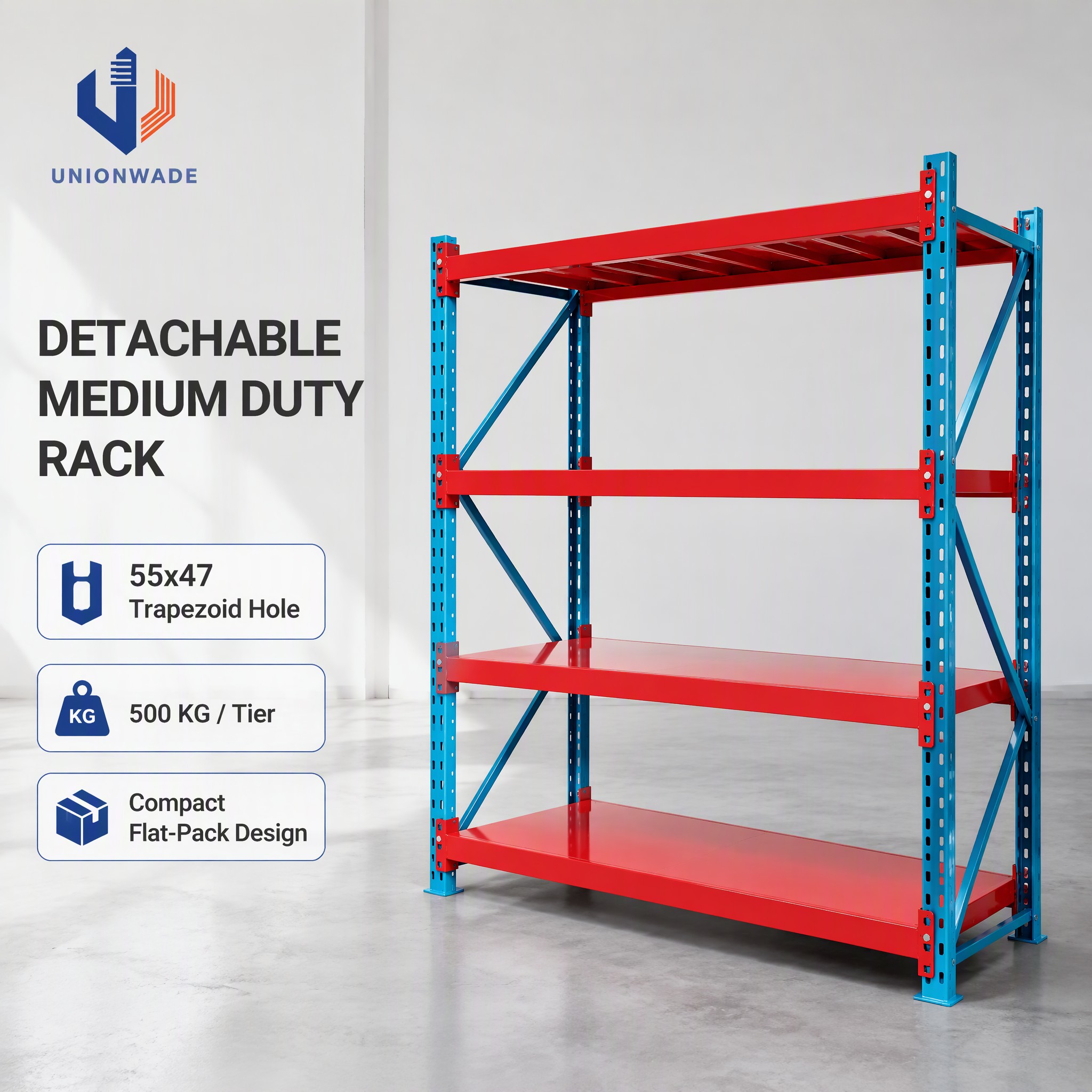
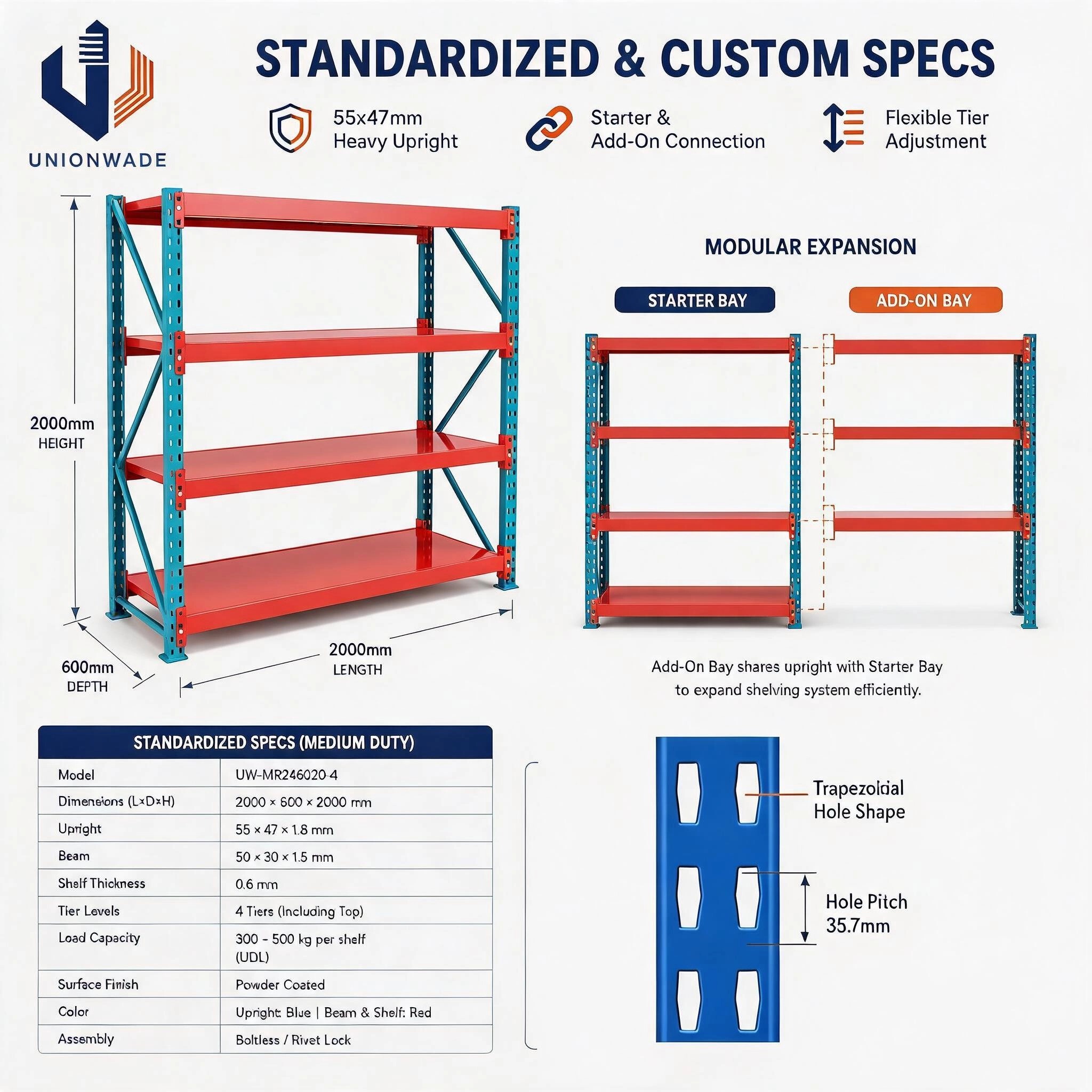
The system described here is Unionwade's medium-duty rivet rack series (W-004). The standard bay, model Uw-MR246020-4, measures 2,000 × 600 × 2,000 mm (length × depth × height) and includes four shelf levels (including the top level). Each shelf has a rated load capacity of 300–500 kg under uniformly distributed loads, with frames powder-coated in blue uprights and red beams and panels.
It is not pallet racking. Unionwade's heavy-duty series (W-005) is rated for 1,500–3,500 kg per level, loaded by forklift, and designed around pallet footprint specifications. A rivet rack is loaded and retrieved by hand. Confusing these two duty classes is how buyers end up with shelving that sags under loads it was never rated to support.
Inside a boltless rivet rack: components and load path
Four components perform all structural work, each with a verifiable function that can be checked against technical drawings.
- Uprights: A 55 × 47 × 1.8 mm section punched with butterfly holes and braced front-to-back.
- Beams: A 50 × 30 × 1.5 mm beam spanning between two uprights to support the shelf panel above.
- Shelf panels: 0.6 mm reinforced steel sheets that distribute loads evenly across the beams.
- Base plates and bracing: Spread column loads onto the floor slab and maintain frame squareness.
Load travels from shelf panels to beams, from beams to uprights, and from uprights to the floor. Each level transfers its weight to the two uprights at its ends—which is why adding levels or storing heavier goods increases the load on each upright, not just the load on each shelf.
Component sections are specifically matched to one another. Substituting a heavier beam from another system compromises the rivet fit and pushes the bay outside its tested load rating. This is why replacement parts should always come from the same system rather than the closest available catalog option.
Butterfly-hole uprights and rivet-lock assembly
The 55 × 47 mm butterfly-hole upright
Uprights feature trapezoidal holes (commonly called butterfly holes) punched at a 35.7 mm pitch. This pitch is a critical practical specification: it determines how finely shelf levels can be adjusted. At 35.7 mm increments, shelves move up or down in steps of roughly 3.5 cm. This allows a 2,000 mm tall frame to be reconfigured for new carton heights without drilling a single additional hole.
Boltless rivet-lock assembly in practice
Beam ends are fitted with rivets shaped to match the butterfly holes. The beam simply drops into place, the rivet seats securely, and the level is locked. No wrenches, torque settings, or bags of bolts are required—even when installing the final bay. The same connection releases easily when the unit needs to be moved.
Two checks should be completed during any handover: every rivet must be fully seated before the first load is placed, and the frame must be re-plumbed and re-leveled after relocation. A rack that stood square in its original building will not automatically be square in a new space.
Load capacity per shelf: reading the rating correctly
The 300–500 kg figure is a rated maximum for the bay, not a target to meet. Four conditions determine whether real-world loads stay within this rating:
- Uniform load distribution. Rated capacity assumes weight is spread evenly across the shelf. A 300 kg motor resting on four small feet is not a 300 kg uniform load.
- Shelf panel condition. A dented panel, or one replaced with a thinner sheet, no longer distributes loads as assumed in the rating calculation.
- Total load per upright. Four levels loaded to 500 kg each place far more weight on each column than a single loaded level—so the sum of all loads matters as much as the individual level rating.
- Floor condition and leveling. A frame standing on an uneven slab loads its uprights unevenly, and the most heavily loaded column will fail first.
For mixed inventory (e.g., cartons on one level, a loaded toolbox on the next), size the bay to the heaviest level rather than the average load across the run.
Starter bay vs add-on bay: building a run
A starter bay is fully self-contained: it includes two uprights, beams, and shelf panels. An add-on bay shares one upright with the adjacent bay, meaning a 5-bay run requires only 6 uprights instead of 10. This is the most cost-effective way to fill a wall, and it ensures every bay in the run has identical height and depth without needing to shim individual frames.
Planning starts with the wall, not the catalog. Measure the available length, choose the 600 mm depth that accommodates your largest boxes, and determine the number of levels based on the tallest item that must fit under a beam. Since runs can be extended later, a common strategy is to install only the bays needed now and leave one end open for an add-on bay as inventory grows.
Medium-duty rivet rack vs heavy-duty pallet rack
These two series are often compared on price per bay, which is the wrong metric. They are differentiated by load capacity and material handling method, and the right choice usually follows directly from these two factors alone.
| Consideration | Boltless rivet rack (W-004) | Heavy-duty pallet rack (W-005) |
| Rated load per level | 300–500 kg per shelf, uniformly distributed | 1,500–3,500 kg per level |
| Handling method | Loaded and retrieved by hand | Loaded and retrieved by forklift |
| Standard level count | 4 levels (including top level) on standard bays | 3–5 levels, with adjustable beam heights |
| Level adjustment | Boltless rivet lock on 35.7 mm butterfly-hole pitch | Beams repositioned to match pallet and load height |
| Shipping form | Flat-packed: bundled uprights, stacked panels, boxed beams | Larger structural frames and beams |
| Typical inventory | Parts bins, cartons, tools, boxed goods | Palletized goods for high-bay and bulk storage |
Put simply: if goods arrive on pallets and are moved by forklift, you need pallet racking. If they are moved by hand or with tote bins, rivet shelving is the more cost-effective and flexible choice. Many warehouses use both systems: pallet racking holds reserve inventory, while rivet bays form the forward pick face.
Where boltless rivet racks excel: spare parts, cartons, and order picking
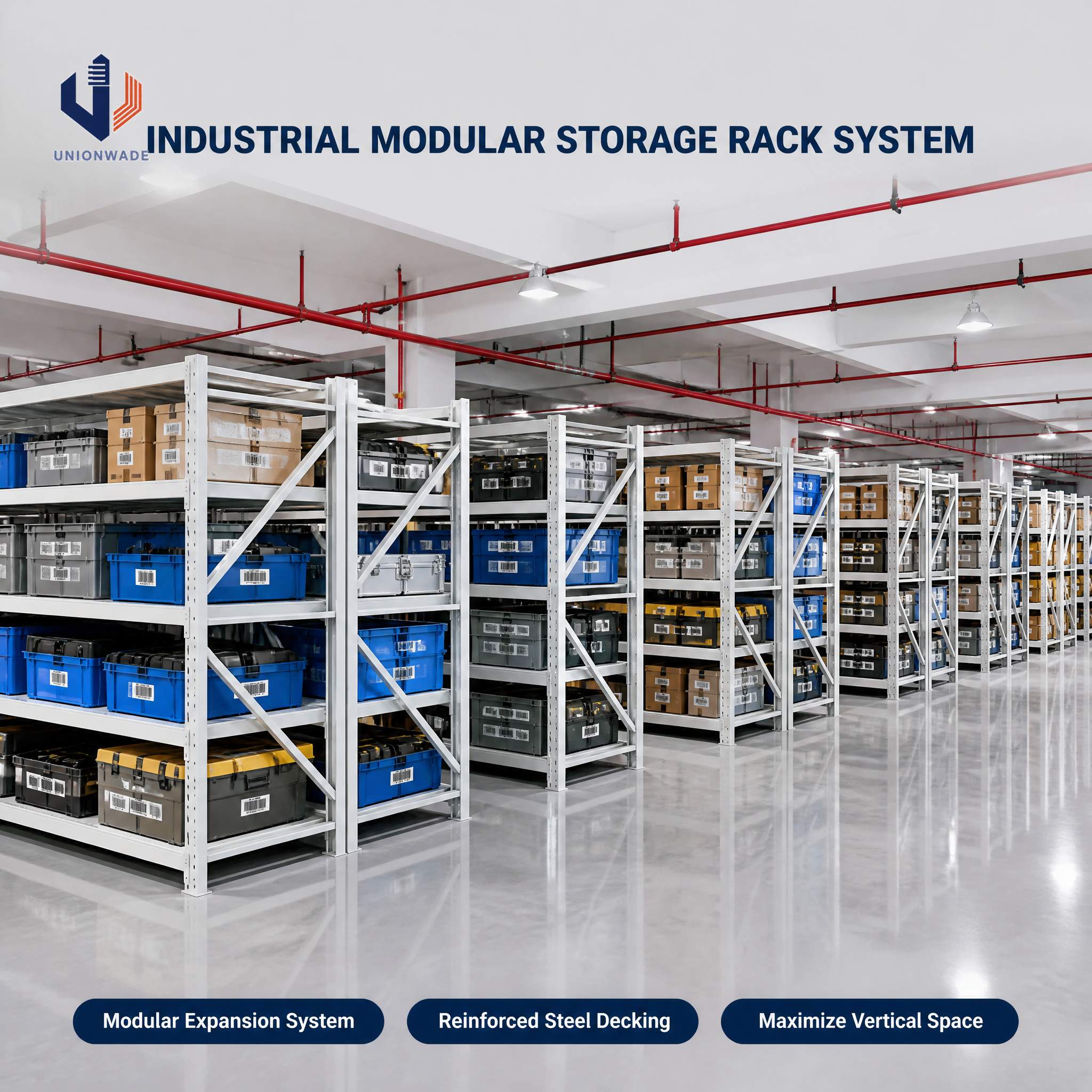
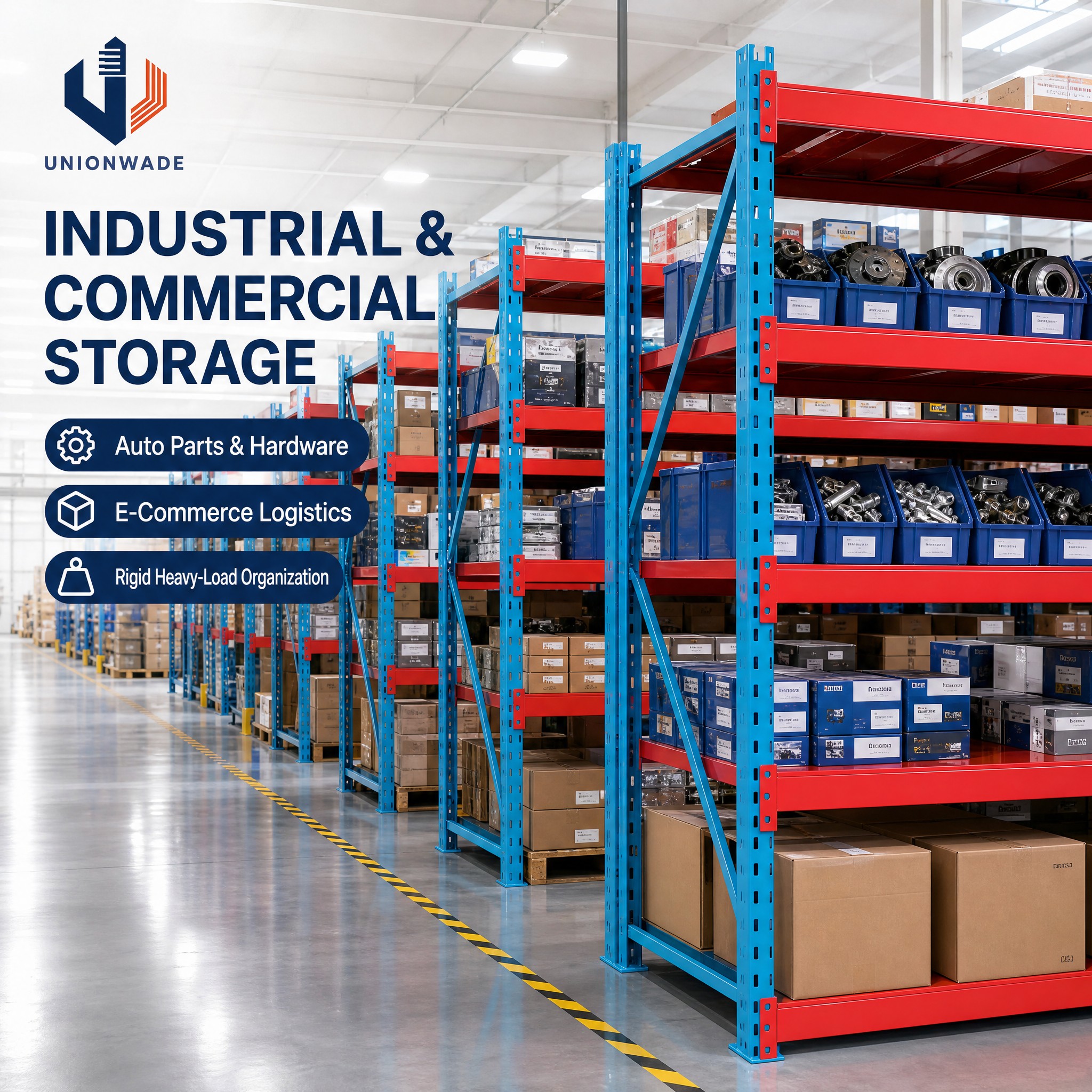
These racks are ideal for environments where inventory is handled by hand: spare parts counters, hardware stores, workshop stockrooms, e-commerce pick faces, general storage rooms, and archives. Bay height is sized for standing workers, the 600 mm depth suits cartons rather than pallets, and the open front keeps labels legible without forklifts in the aisle.
They are also perfect for operations that are still evolving: rented facilities, seasonal overflow storage areas, or workshops that reorganize twice a year. Fixed shelving is a poor fit here, as every layout change requires dismantling and rebuilding frames.
Flat-pack shipping, packaging, and finishes
Because components separate fully, units ship flat-packed. Uprights are bundled, panels are stacked, beams are boxed, and the entire bay is strapped and wrapped into a compact package that maximizes container space. Corner protectors shield upright ends, coated surfaces are protected against rust during transit, and packages are stackable. Packaging is a core part of the product here: a bay that arrives dented or twisted cannot be assembled square, regardless of what technical drawings specify.
Finishing is powder coating with RAL color matching. Standard bays use blue uprights with red beams and panels; custom colors and logo printing are available for distributors selling under their own brand.
Rivet racks are manufactured in a 46,000+ square meter facility equipped with a 500-tonne press for hole pattern stamping, roll-forming lines for uprights and beams, robotic welding, and a powder coating line. The operation has delivered over 1,000 projects with a team of more than 50 people. All projects follow four documented steps: inquiry and requirements gathering, layout and engineering, quotation and sample approval, then packing and shipping with complete export documentation.
For the current full range of bays, see medium-duty rivet shelving (W-004). For forklift-loaded pallet storage needs, compare the heavy-duty rack series (W-005), and for broader context, read how to specify heavy-duty pallet racking.


