Drive-In Racking: How Deep Lanes Work, and What They Cost in Selectivity
News Details
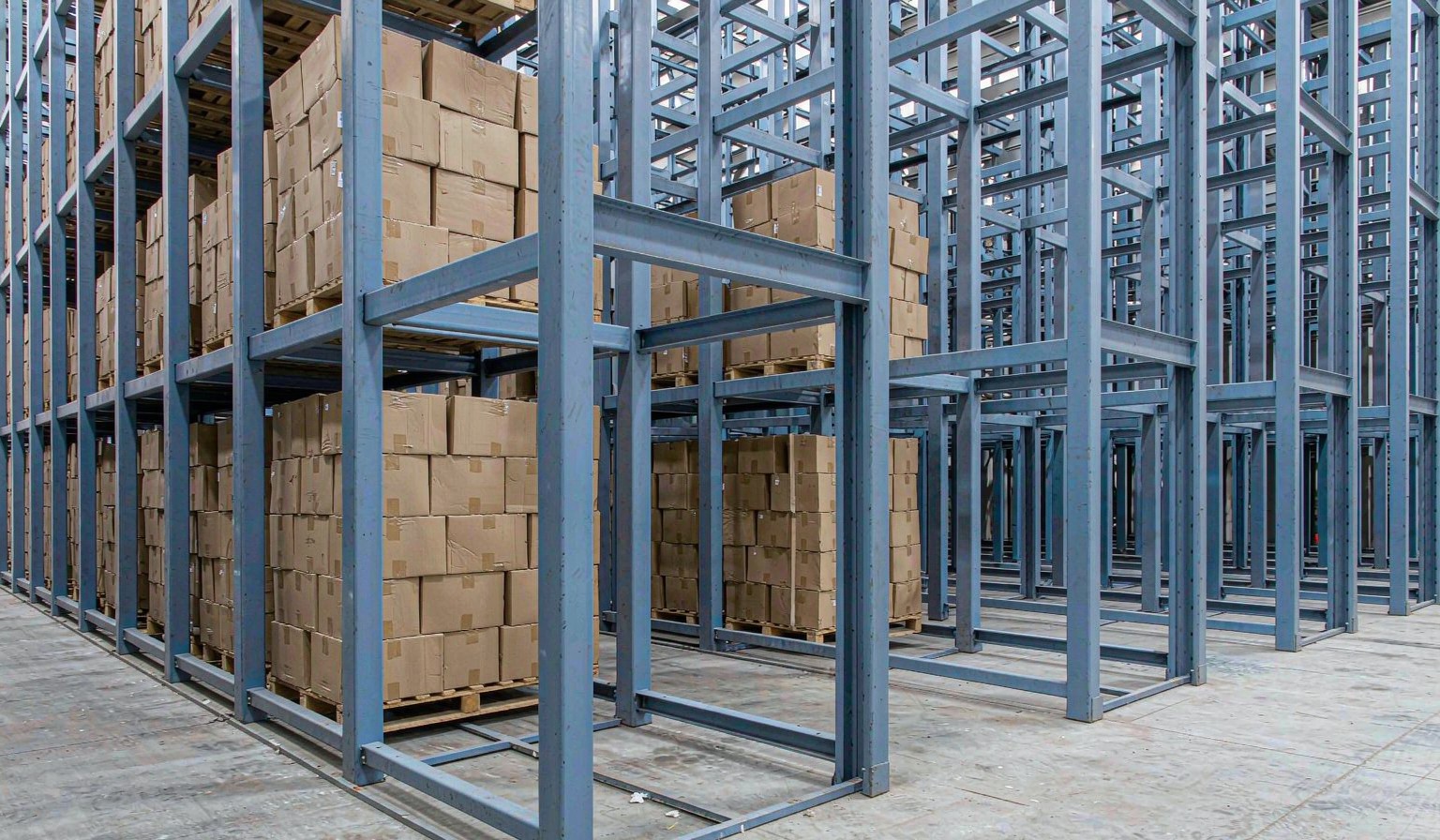
Drive-in racking — also called drive-in pallet racking — is the system you specify when pallet count matters more than the ability to pick any pallet at any moment. Instead of beams spanning a bay with a working aisle in front of it, a drive-in block is a continuous run of upright frames with deep lanes between them: no front column inside the lane, pallets resting on rails along both sides, and a single working aisle serving the whole block. A forklift drives into the lane, sets the pallet at the deepest free position and reverses out.
That one decision — trading selectivity for density — changes the layout, the truck, the pallet specification, the protection budget and the stock policy. This guide sets out how the structure works, where the density claims come from and where they leak away, and what a buyer needs to put in front of a supplier before a lane schedule can be priced.
What a Drive-In Block Is Made Of
Four components do the work. Upright frames form the side walls of every lane, spaced far enough apart to pass a truck and its load. Horizontal pallet support rails run the full depth of the lane at each storage level, one rail on each side, and the pallet sits across the pair by its outer edges. Vertical and horizontal bracing ties the frames together in the depth direction, because a drive-in block has no beam grid to stiffen it the way selective racking does. And floor-level guide rails steer the truck down the centre of the lane.
The result is a structure that behaves differently from a selective rack. Loads sit between the frames rather than on beams between them, so each upright carries the cumulative weight of every pallet above and beside it, multiplied by the number of pallets deep in the lane. That is why a drive-in block is engineered as a whole — lane depth, level heights and pallet weights are design inputs, not catalogue choices. Unionwade's drive-in rack is built on this principle: high utilisation for large quantities of same-size pallets, with loading from the innermost position outward and picking in reverse order.
Drive-In vs Drive-Through: One Aisle or Two
Drive-through racking uses the same lanes and the same rails, but the block is open at both ends. Pallets go in one face and come out the other. That single change buys first-in, first-out rotation and costs floor space, because the block now needs a working aisle on both sides instead of one. The structure also needs additional bracing, since there is no back wall to help tie the frames together.
| Factor | Drive-in | Drive-through |
| Open faces | One | Two |
| Stock rotation | LIFO (last in, first out); some suppliers write FILO | FIFO possible, load one face and pick from the other |
| Aisles required | One working aisle | One at each face |
| Placement | Can sit against a wall | Needs access and clearance at both ends |
| Structure | Closed back helps tie the block | Extra bracing for the open end |
| Typical stock | Long-life bulk, seasonal build-up, buffer stock | Dated or perishable stock that must rotate |
The decision is rarely about steel cost. It is about whether the stock can tolerate last-in, first-out, and whether the building has room for the second aisle. Where rotation is mandatory and the floor area is tight, the honest answer is often that drive-in is the wrong family and a live pallet or shuttle system should be evaluated instead.
LIFO in Practice: One Lane, One SKU
A drive-in lane is worked from the back. The first pallet goes to the deepest position on the lowest level, and each level above is filled at that depth before the lane advances one position toward the aisle. Unloading runs the other way: the front pallet leaves first, then the next one behind it, and the truck drives deeper as the lane empties. Only the front pallet of each level is directly accessible.
This is why a lane is committed to a single SKU. Mix two products in one lane and the one at the back becomes unreachable until everything in front of it has gone. It is also why lane depth has to be matched to realistic stock levels, not to the best case. A five-deep lane dedicated to a line the operation only ever holds two pallets of will spend most of its life half empty, and those empty positions cannot be reassigned without clearing the lane.
Two operating rules follow. Count the lane as the unit of stock, not the pallet position, so replenishment is planned in lane-sized batches. And keep damaged pallets out of the lanes entirely — a lane is far less forgiving of a broken bottom board than a beam-supported bay.
Pallet Rails Decide What Can Be Stored
A pallet in a drive-in lane rests on two narrow strips of steel, one under each outer edge, and nothing else supports it. That geometry puts the whole load on the pallet's bottom boards and on the short length of rail in contact with them. Three consequences follow, and each one catches buyers who assume any pallet will do.
- Bottom board orientation matters. The boards must run across the rails, not parallel to them, or the pallet has almost no bearing area.
- Pallet condition is structural. A cracked stringer, a missing board or a sagging deck can let the load drop between the rails. Damaged pallets have to be rejected at the lane entry, not at the top level.
- Pallet size and type are fixed by the design. An undersized pallet, or one of a different footprint from the type the lane was engineered for, can slip through. Plastic and steel pallets behave differently here: the deck flexibility, friction and edge profile of each type change how the load sits on a rail, so the pallet type belongs in the enquiry alongside the weight.
Rail pitch and rail section are engineered together with the pallet, which means the pallet drawing belongs in the enquiry. A supplier asked to quote without it is guessing.
Sizing the Lane Around the Truck
The truck sets the lane width, not the pallet. Frames are spaced to give the forklift body, mast and overhead guard safe clearance at every level, with the narrowest clearance typically found where the mast passes the frame faces. A counterbalance truck and a reach truck have different envelopes, and a truck changed after the rack is designed is a design change, not a like-for-like swap.
Cutting the lane to the minimum is a false economy. Clearances of a few centimetres on each side leave no margin for a worn tyre, a wet floor or a driver who is one degree off line at the top level, where the pallet is being placed well in front of and above the operator. Practical layouts keep a margin, restrict lane speeds — 5–8 km/h is a common site limit — and assign the most experienced drivers to the block. Two trucks in one lane at the same time should be a written prohibition, not an assumption.
Floor condition deserves the same attention. A truck travels several metres into a narrow lane, so a slab that is flat enough for an open aisle can still put the forks off level at depth. Where flatness is marginal, grinding or shimming is cheaper before installation than after the first damaged upright.
Guide Rails, Lead-Ins and Protection
Drive-in racking takes more impacts than any other pallet system, because trucks work inside the structure rather than in front of it. Protection is part of the design, not an accessory added after the first insurance claim. Four items do most of the work:
- Floor guide rails along both sides of each lane keep the truck central and its wheels away from the uprights, with flared or rounded entry ends so a slightly misaligned approach is guided in rather than stopped dead.
- Lead-ins on the pallet rails turn a square rail end into a chamfered nose, which is far more forgiving when a pallet catches the rail on the way in. A pallet that rides up a bare rail end can drop a load.
- Column protectors on the front uprights at each lane entry, where the structure is closest to the turning truck and takes the most hits.
- Pallet stops at the rear of each lane so the first pallet cannot be pushed out of the back of a drive-in block.
Misaligned guide rails are a leading cause of drive-in rack damage, which is why alignment should be checked with a laser or a string line at installation and re-checked after the first weeks of operation, when the slab and the anchors have settled into service.
Density and Honeycombing: The Real Occupancy Figure
Drive-in racking is sold on space utilisation, and the headline number is usually above 80 percent, because the service aisles are gone and the block fills the floor. That figure holds only when every lane is full. Pull a few pallets from the front of several lanes and the empty positions behind them cannot be used for another product, so real occupancy drops. Operators commonly report figures in the high sixties to mid seventies percent once a live SKU range is in the block.
The commercial comparison should therefore be cost per stored pallet, not cost per bay. A drive-in bay costs more than a selective bay — more rails, more bracing, more steel per position — but it stores several times as many pallets behind the same aisle. Compare total installed cost, including protection and installation, divided by usable positions at realistic occupancy. If the honest number is close to selective racking, the flexibility of selective is worth more than the density.
Where the constraint is floor area rather than pallet count, a different answer may be cheaper: a mezzanine or steel platform adds usable floor without changing the storage philosophy. Our guide to mezzanine rack and steel platform systems covers that route.
Drive-In in Cold Stores
Cold storage is the application where drive-in earns its place most clearly, because every aisle removed is refrigerated volume that no longer has to be cooled, lit or cleaned. Fewer aisles also mean less air movement and less frost on the structure. The trade-offs are real, though. Forklift performance falls at low temperature, floor slabs in freezers are subject to frost heave, and a truck that stops inside a lane blocks the only way out.
Design changes for a freezer installation include a coating system or galvanised finish suited to permanent high humidity and repeated freeze-thaw cycling, base plate and anchor details checked against the slab's condition, and a traffic and safety plan that assumes slower truck speeds and longer task times. Rating labels in a freezer need to stay legible at −25 °C; laminated paper signs do not.
When to Step Up to Shuttle, or Back to Selective
Drive-in is a static system: no carts, no controls, nothing to maintain beyond the structure and the pallets. That simplicity is the reason it survives in operations that could afford automation.
It stops being the right answer in three situations. If lanes must be deep — beyond roughly six to eight pallets — the driving distance inside the rack makes the cycle slow and the damage risk high, and a shuttle system that carries the pallet in on a radio-controlled trolley becomes the better investment. Unionwade's automatic shuttle rack keeps the density of a drive-in block while supporting both FIFO and LIFO, which removes the one-SKU-per-lane constraint. If every pallet must be accessible on demand, selective racking wins and always will. And if the building is tall but the floor is constrained rather than the pallet count, narrow aisle pallet racking uses a different lever: fewer, narrower aisles with a specialist truck, keeping selectivity.
Mixed layouts are normal and usually correct. A distributor may run selective racking for fast-moving pick faces, a drive-in block for slow-moving bulk, and one rack type per inventory family, with capacities, component identification and operating instructions kept clearly separate for each system.
What to Send With a Drive-In Enquiry
A drive-in quote is only as good as the inputs. These are the items that change the steel:
- Pallet footprint, height and maximum loaded weight, plus the pallet type and a drawing or photo, including bottom board direction.
- Pallets per lane (lane depth), number of levels, and the clearance needed above each unit load.
- SKU profile: how many product lines, pallets per line, and whether stock is seasonal or continuous.
- Forklift make and model, including mast and overhead guard dimensions, and whether a reach truck is planned later.
- Aisle width available, building clear height, and any sprinkler, lighting or roof obstruction above the block.
- Floor slab information: thickness, construction, flatness and condition, plus anchor pull-out data if available.
- Environment: ambient, chiller, freezer or outdoor, with the temperature range and any washdown or chemical exposure.
- Rotation requirement, stated plainly. If the answer is FIFO, the enquiry should be for drive-through or shuttle, not drive-in.
- Destination port, container loading constraints and required documentation.
The drawings that come back should state lane depth, level heights, load rating per level and per frame, pallet size assumed, rail section, bracing arrangement, protection schedule and anchor specification. A capacity figure with no pallet size and no lane depth attached is not a rating, it is a hope. For the wider picture on how rack capacity is established and what a rating excludes, see our guide to heavy duty pallet racking systems.
Frequently Asked Questions
Is drive-in racking FIFO or LIFO? LIFO, sometimes written FILO: the last pallet into a lane is the first one out. Drive-through, the same structure open at both ends, allows FIFO.
How deep can a drive-in lane be? Depth is limited by truck performance, driving distance inside the rack and the stock profile, not by a fixed rule. Beyond about six to eight pallets deep, the case for a shuttle system strengthens quickly.
Can drive-in racking be used outdoors? It can, with a finish and anchor specification suited to the exposure. Wind loading and drainage then become design inputs that an indoor layout never considers.
Does drive-in racking need a special forklift? No, a standard counterbalance or reach truck works, but the lane is designed around a specific truck envelope, and a change of truck means re-checking the design.


